


The popular Indian automotive brand Tata Motors continues to lead India’s electric car market with a wide range of EVs spread across different models and price points below Rs 30 lakh to cater middle class car users. Let’s explore the Tata Sierra EV review in this blog covering its design, interior, performance, range, features and overall driving experience.
India’s largest electric car manufacturer has a solid EV lineup that includes the Tiago EV, Tigor EV, Punch EV, Nexon EV, Curvv EV, Harrier EV and Tata Sierra EV. Prices range from Rs 6.99 lakh to Rs 30.43 lakh (ex-showroom) giving Tata a strong presence across the electric car segment.
Key Highlights:
- Distinctive boxy SUV design
- Spacious and premium cabin
- 12.3-inch infotainment and passenger screens
- 75 kWh battery with up to 624 km MIDC range
- QWD dual-motor setup with 306 PS and 504 Nm
- Strong performance with 0-100 kmph in 5.8 seconds
- Prices start at Rs 18.79 lakh (ex-showroom)
The Tata Sierra EV is the latest addition to this lineup following the launch of its ICE counterpart last year. We drove the top-spec Empowered A 75 kWh QWD Dual Motor version priced at Rs 25.99 lakh (ex-showroom) to find out what Tata’s newest electric SUV brings to the table.
Tata Sierra EV Review: Exterior design and features
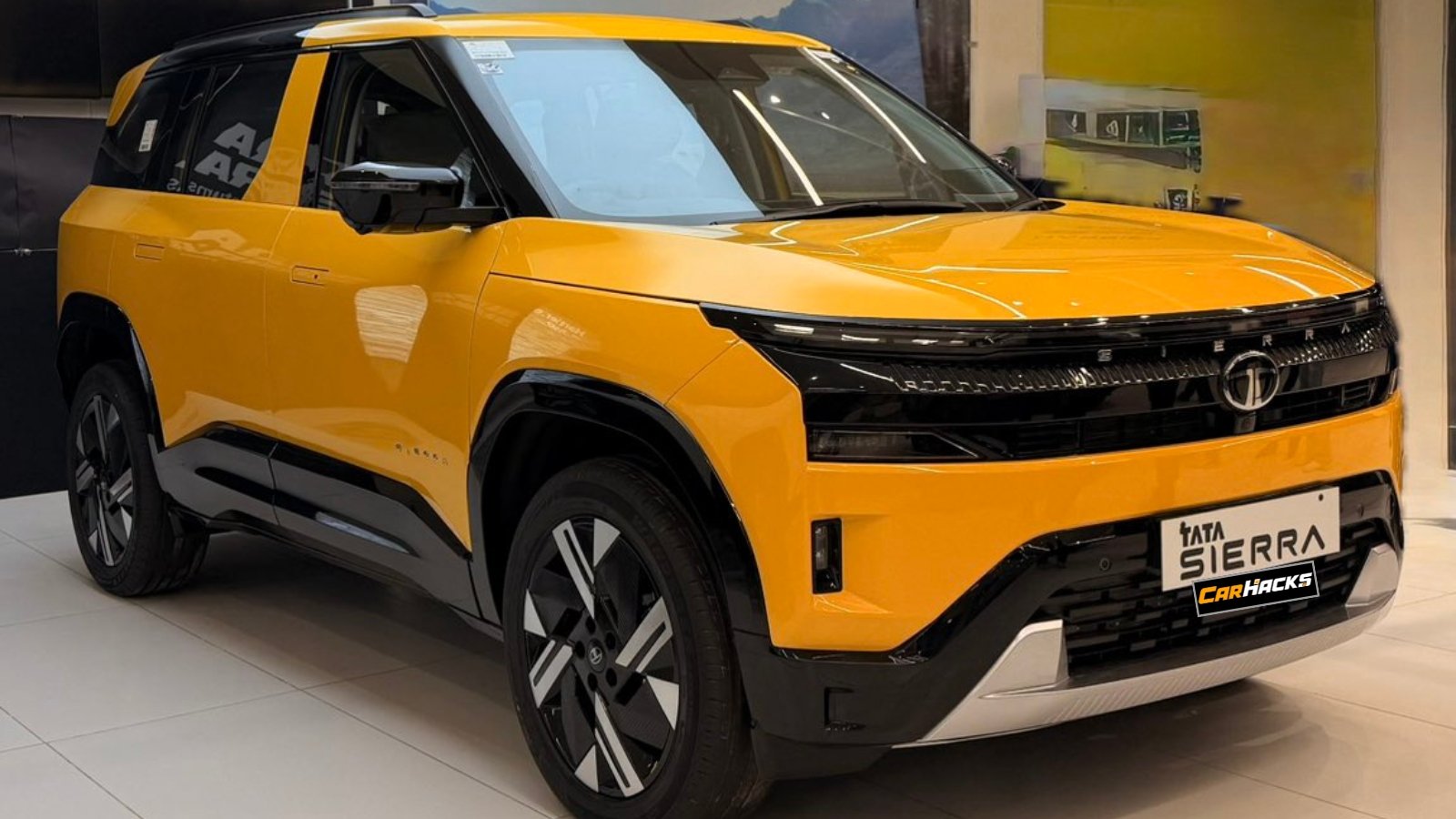
With the ICE Sierra already on sale it is hard not to compare the two. From the side the Tata Sierra EV carries much of the same upright stance boxy shape and distinctive rear window treatment.
The differences are more noticeable from front. The Tata Sierra EV gets a cleaner face without a traditional grille while the Tata logo takes the place of the SIERRA lettering similar to the ICE version. The LED lighting setup remains mostly unchanged.
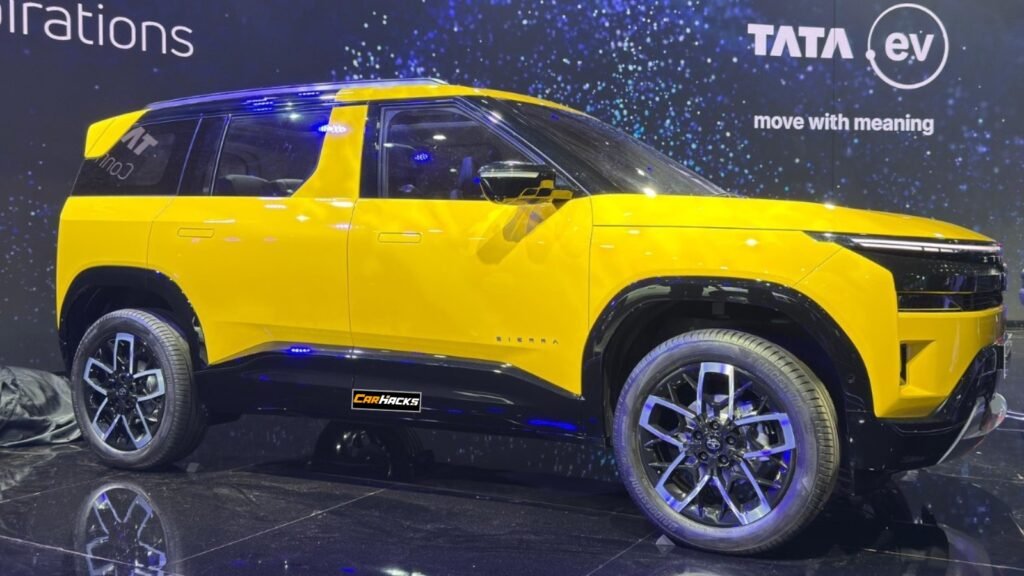
Tata.ev badges on the sides highlight its electric powertrain while the QWD Dual Motor lettering on the rear quarter glass identifies the most powerful version. The 19-inch alloy wheels add to its sporty appearance and sit nicely within the wheel arches.
The rear has a similar design to the ICE Sierra including the LED tail lamps and clamshell tailgate. The Sierra.ev measures 4,340 mm in length, 1,841 mm in width and 1,750 mm in height. It has a 2,730 mm wheelbase and 205 mm of unladen ground clearance. Its chunky styling gives it plenty of road presence and hints at the more premium cabin experience.
Tata Sierra EV Review: Interior features and space
The Tata Sierra EV provides good space into the cabin. The multi tone colour scheme and wide horizontal dashboard give the interior an airy feel while the overall finish suits its premium positioning.
The dashboard is similar to the ICE Sierra that has three screens: a 12.3-inch infotainment unit, a 12.3-inch display for the front passenger and a 10.25-inch digital instrument cluster. During our drive the two touchscreen displays were quick to respond and fairly simple to operate.
The 360-degree camera could have been better. That stands out more because the Sierra.ev places such a strong focus on technology.
The touch operated climate controls are another area that takes some getting used to. They look neat and modern but require a little more attention than physical switches. On busy Indian roads even a brief glance away can be distracting. It may become second nature with time but we would prefer Tata to bring back physical controls in a future update.
The SonicShaft soundbar is a much better example of technology being used well. Combined with the 12-speaker JBL Black system and Dolby Atmos it delivers a rich and immersive audio experience. Music sounds clear while navigation instructions are easy to hear.
The front seats are wide and supportive although they feel slightly firm. That said they are not uncomfortable and the extendable thigh support should be useful on longer drives. Ventilation a six-way powered driver’s seat with memory and a four-way powered co-driver’s seat are also part of the package.
Equipment is extensive with dual-zone climate control a panoramic sunroof, HypAR head-up display, Level 2+ ADAS, Summon Mode, reverse assist, Mappls navigation, iRA.ev connectivity and a 540-degree view with adaptive turn cameras. The e Valet system adds further assistance for parking and low-speed manoeuvring. Safety features include six airbags all-wheel disc brakes, ISOFIX mounts and electronic stability control.
Two features in Tata Sierra EV particularly caught our attention. AirConsole described by Tata as an India-first, allows passengers to play games on the infotainment screen by scanning a QR code and using their smartphones as controllers.
The EV route planner for Android Auto is another feature Tata describes as an India-first. It shows the expected battery level at the destination and highlights charging points along the route. Unlike some gimmicky features this one could genuinely be useful for longer EV trips.
Despite the amount of technology in this new Tata Sierra EV practicality has not been overlooked. The 2,730 mm wheelbase creates plenty of room inside while the official boot capacity stands at 622 litres. Space up to the parcel tray is around 420 litres. The boot itself has a wide opening and a practical shape for carrying family luggage. The QWD system though gives this otherwise family-friendly SUV a much sportier side.
Tata Sierra EV Review: Powertrains
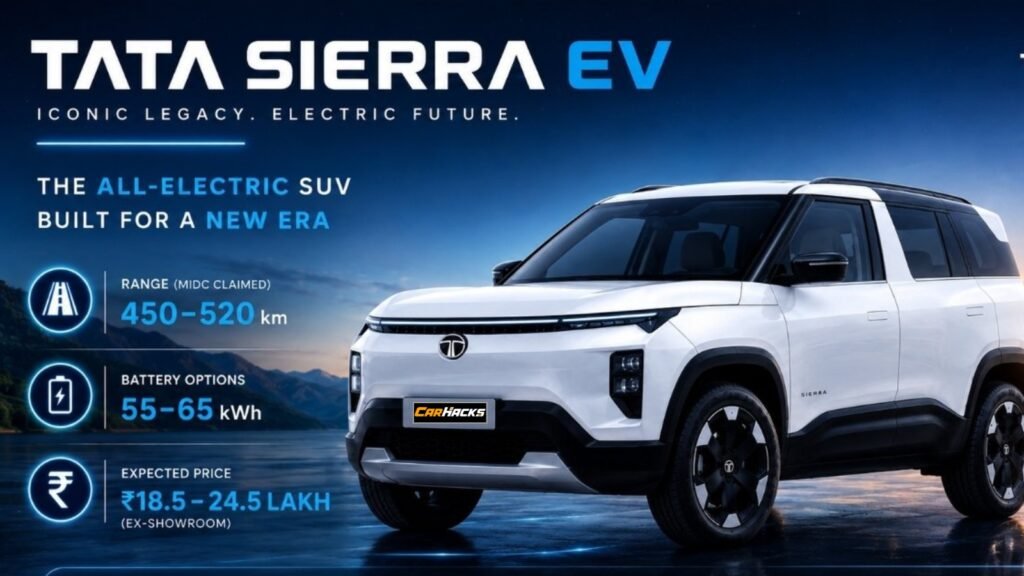
The Tata Sierra EV is available with 63 kWh and 75 kWh battery packs. Both can be had with rear-wheel drive while the larger battery is also available with a QWD dual-motor setup on the top Empowered A variant.
The 63 kWh RWD version uses a rear permanent-magnet synchronous motor producing 238 PS and 315 Nm. It has a certified MIDC range of 566 km and a claimed C75 real-world range of 440-460 km. The 75 kWh RWD model produces 209 PS and 315 Nm with a 665 km MIDC range and claimed C75 range of 510-530 km.
Our review car used the 75 kWh QWD setup combining a front induction motor with a rear permanent-magnet synchronous motor. Together they produce 306 PS and 504 Nm. Tata claims a 0-100 kmph time of 5.8 seconds in Boost mode. Its official MIDC range is 624 km while the claimed C75 real-world figure stands at 480-500 km.
On the road those figures are backed up by strong performance. The QWD Tata Sierra EV feels lively in all four modes- Eco, City, Sport and Boost. Eco and City are more than adequate for everyday driving, Sport makes the response sharper while Boost brings out the full potential of the dual-motor setup. For an SUV of this size and weight, it is seriously quick.
We also tried all four levels of regenerative braking. Level 0 provides no regeneration while Level 3 offers the strongest effect. The steering-mounted paddles make it easy to switch between them.
The QWD model also gets Normal, Grass/Snow, Mud-Ruts/Gravel, Sand, Rock Crawl and Custom terrain modes, along with off road assist. However we mostly drove to city roads so we could not properly test its off road capability.
The difference between performance and range was noticeable. Based on the distance covered and battery used we estimated around 475 km in Eco and 450 km in City from a full charge. Regular use of Sport and Boost brought the estimate down to around 350 km. Real-world figures will naturally depend on traffic, speeds, air-conditioning use, driving habits and road conditions.
Tata says the 75 kWh battery can gain up to 263 km of range in 15 minutes and charge from 20% to 80% in about 26 minutes using a compatible DC charger. A 7.2kW AC charger takes around 10.5 hours to go from 10% to 100%. With that kind of performance the chassis also needs to keep the SUV’s weight under control.
Tata Sierra EV Review: Ride and handling
For the most part the Tata Sierra EV delivers a comfortable drive. Despite its size and weight it feels easy to handle in city traffic. Power delivery is smooth and the instant response of the electric motors makes overtaking and finding gaps fairly effortless. You can feel the weight but it never makes the SUV feel awkward around town.
The Ultra Glide suspension uses frequency-dependent damping along with a multi-link rear setup. It dealt with potholes and broken patches of road well, keeping the cabin settled. This is in line with the comfortable ride quality we have come to expect from Tata SUVs.
The steering could offer more confidence at higher speeds. The Tata Sierra EV gets to triple-digit speeds without much effort, but a little more weight through the wheel would make the experience feel more reassuring.
Our test vehicle also had a slight steering-wheel alignment issue. It was noticeable during our drive but it would not be fair to assume the same issue will affect production-spec Sierra.ev models.
Tata Sierra EV: Price and variants
The 63 kWh RWD lineup starts at Rs 18.79 lakh for the Pure variant. The Pure S costs Rs 19.99 lakh followed by the Adventure at Rs 20.99 lakh and the Empowered at Rs 22.79 lakh.
The larger 75 kWh battery is available with the RWD Adventure at Rs 22.19 lakh, the Empowered at Rs 23.79 lakh and the Empowered A at Rs 24.79 lakh. The QWD dual-motor setup is available only with the top-spec Empowered A taking the price to Rs 25.99 lakh which is the version tested here. All prices are introductory and ex-showroom.
The 7.2 kW AC fast charger costs another Rs 49,000 with charger and installation charges not included in the vehicle prices. Even in its most expensive form the Sierra.ev sits below the larger Harrier.ev giving Tata a clear price gap between the two electric SUVs.
Tata Sierra EV Review: Verdict
As an overall package the Tata Sierra EV feels well placed in Tata’s EV lineup. It offers the technology space and performance expected from a premium electric SUV without stepping too close to the larger Harrier.ev.
There is plenty to like. The cabin is roomy the equipment list is generous and the QWD version delivers more than enough performance for everyday use. Eco and City modes work well for regular driving, while Sport and Boost add plenty of excitement when required. The range we observed in Eco and City also makes the Sierra.ev suitable for longer trips.
It is not without shortcomings. The camera quality could be better, the touchscreen climate controls need more attention than they should and the steering would benefit from added weight at higher speeds. The alignment issue is also worth checking on a customer-spec car, although Tata has linked it to the pre-production vehicle we drove.
Also read: New Skoda Slavia Facelift
Even so these drawbacks do little to take away from the overall package. The Tata Sierra EV combines distinctive styling a spacious interior, comfortable ride quality plenty of features and strong performance. At Rs 25.99 lakh the QWD version offers a convincing mix of technology, practicality and capability.
For buyers looking for a premium electric family SUV below Rs 30 lakh the Tata Sierra EV makes a strong case for itself. It also gives Tata another product to build on its position in India’s growing electric car market.