

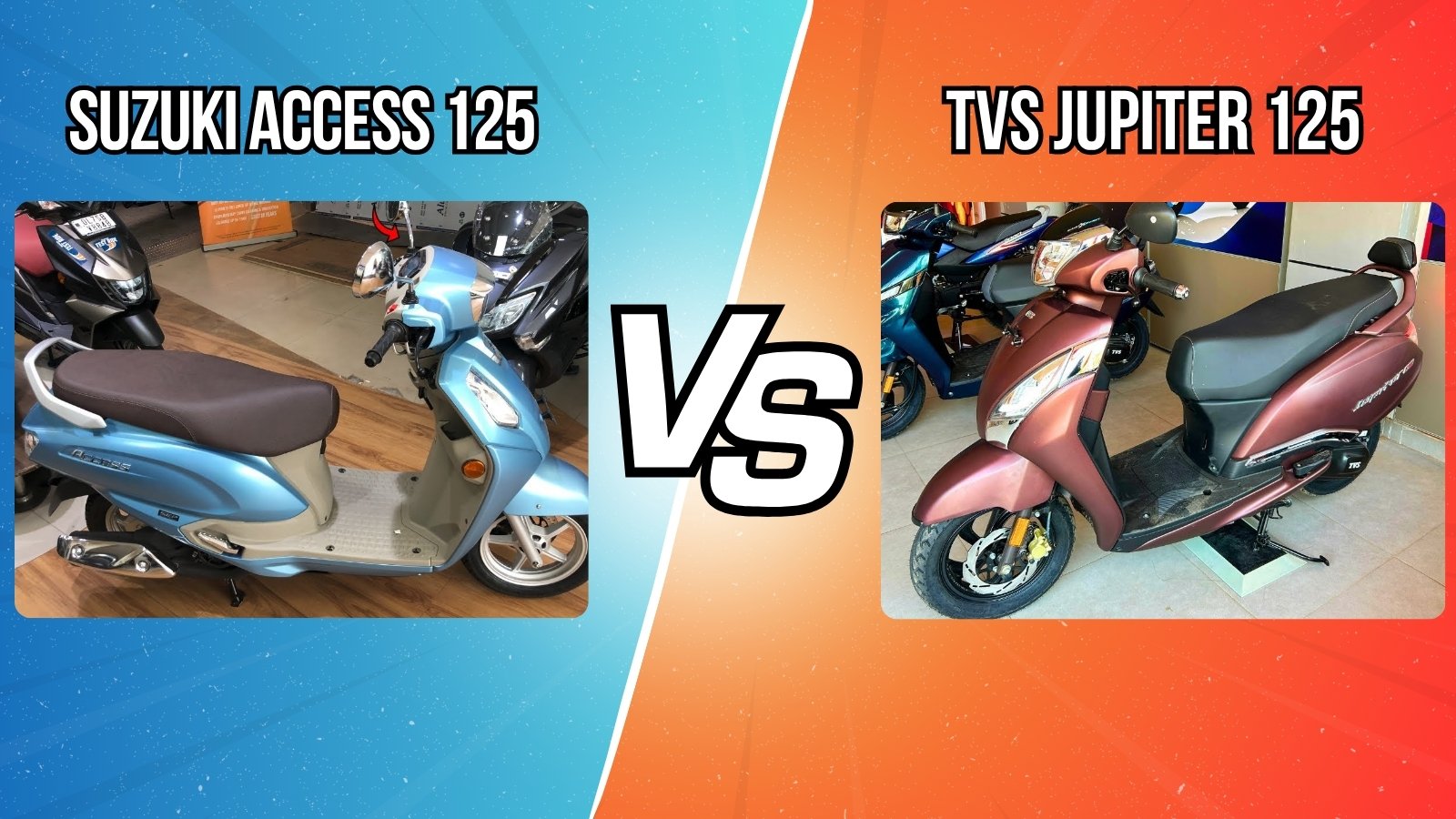

The most popular two wheeler scooter segment is growing rapidly in Indian automotive market. Companies are trying their best to lure customers in 125cc family scooter. Buyers tend to go for a good scooter that can carry a small family comfortably offer enough storage for everyday shopping and still look good enough. The Suzuki Access 125 and TVS Jupiter 125 aim to cover all these needs while providing useful features.
That makes the choice between them a little tricky. Here’s detailed Suzuki Access 125 vs TVS Jupiter 125 Comparison across price, design, practicality, features and performance.
Suzuki Access 125 vs TVS Jupiter 125: Price and Variants
| Suzuki Access 125 | Price (ex-showroom, Delhi) | TVS Jupiter 125 | Price (ex-showroom, Delhi) |
| Standard Edition Drum Brake (Std) | Rs 82,185 | Drum Alloy | Rs 81,700 |
| Special Edition Disc Brake (SE) | Rs 87,827 | Disc | Rs 86,110 |
| Ride Connect Edition Disc Brake + Alloy Wheels (RC) | Rs 90,727 | DT SXC | Rs 88,950 |
| Ride Connect TFT Edition (RCT) | Rs 93,877 | SmartXonnect | Rs 89,935 |
| Ride Connect ABS Edition (RC ABS) | Rs 96,230 | — | — |
| Ride Connect TFT ABS Edition (RCT ABS) | Rs 1,01,279 | — | — |
- The TVS Jupiter 125 has lower price and gets machine cut alloy wheels as standard.
- The Suzuki Access 125 costs a little more in comparable variants but offers a full LCD instrument cluster as standard.
- Both scooters have similar feature combinations across their respective variants. The Access 125 also gets two additional versions with single-channel ABS.
- TVS offers a 5 year/50k km standard warranty on the Jupiter 125. Suzuki offers 2 years/24k km with the Access.
- Suzuki does offer extended coverage of up to 10 years/76k km as an optional package.
Suzuki Access 125 vs TVS Jupiter 125: Dimensions and Design
| Specification | Suzuki Access 125 | TVS Jupiter 125 | Difference |
| Length | 1,835 mm | 1,852 mm | -17 mm |
| Width | 680 mm (Std) / 690 mm (SE/RC) | 691 mm | -11 mm/-1 mm |
| Height | 1,155 mm | 1,168 mm | -13 mm |
| Wheelbase | 1,260 mm | 1,275 mm | -15 mm |
| Ground Clearance | 160 mm | 163 mm | -3 mm |
| Seat Length | 856 mm | 790 mm | +66 mm |
| Seat Height | — | 765 mm | — |
| Kerb Weight | 107 kg (Std) / 106 kg (SE/RC) | 109 kg / 108 kg | -2 kg |
| Fuel Tank | 5.3 litres | 5.1 litres | +0.2 litre |
| Colour Options | 6 | 11 | -5 |
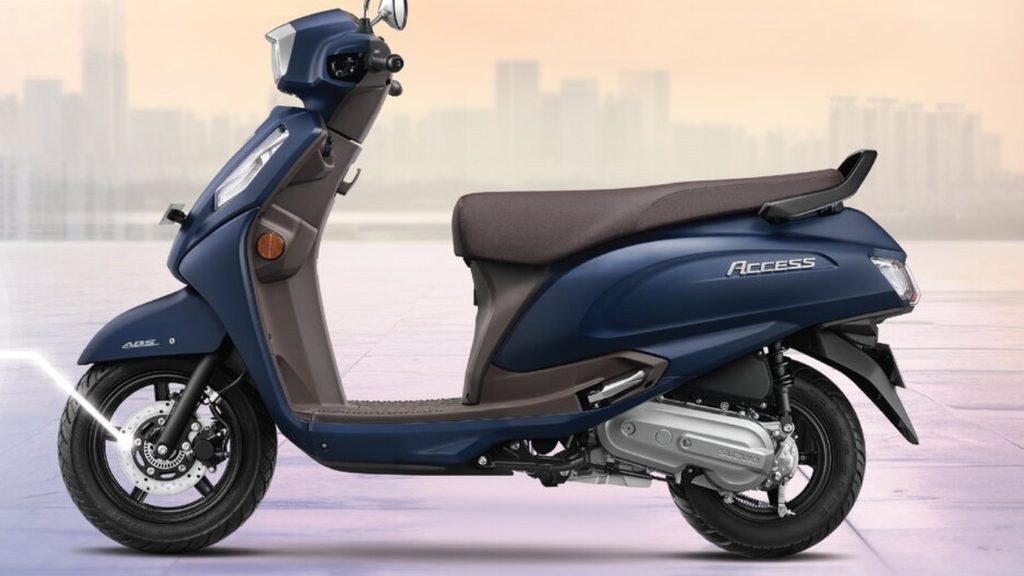
Both scooters are similar in size and same ground clearance. The Access 125 has a shorter wheelbase which gives it a slightly more agile feel in traffic. The Jupiter 125 gets a longer wheelbase which helps with stability at higher speeds.
The Access is also slightly lighter. The Jupiter has a marginally lower seat height, so both should be easy enough to manage for most riders. The Suzuki does have a longer seat which gives it an advantage when carrying a pillion.
Both scooters have different designs. The Access 125 has a more premium neo retro look with clean lines, a rectangular headlamp, round mirrors and subtle chrome details. The Jupiter 125 takes a more contemporary approach with a sharper front-end design, diamond-cut alloy wheels and a slightly more angular stance.
Suzuki Access 125 vs TVS Jupiter 125: Ride and Handling
| Specification | Suzuki Access 125 | TVS Jupiter 125 |
| Frame | Under Bone-Type | Under Bone-Type |
| Front Suspension | Telescopic Fork | Telescopic Fork |
| Rear Suspension | Single-sided, spring-loaded hydraulic shock absorber | Single-sided, spring-loaded hydraulic shock absorber |
| Front Tyre | 90/90-12, Tubeless | 90/90-12, Tubeless |
| Rear Tyre | 90/100-10, Tubeless | 90/90-12, Tubeless |
| Wheels | Steel (Std) / Alloy (SE/RC) | Alloy |
| Front Brake | Drum (Std) / Disc (SE/RC) | Drum (Std) / Disc |
| Rear Brake | Drum (CBS) | Drum (SBT) |
Both scooters use underbone frames with telescopic forks at the front and a rear hydraulic shock absorber. Their basic suspension setup is quite similar. The Jupiter 125 gets a 3 step adjustable twin tube emulsion shock which gives some flexibility in setting up the ride.
Both use the same front wheel and tyre size. The Jupiter’s larger rear wheel should handle broken roads better while the smaller rear wheel on the Access contributes to its lighter and more agile character.
Braking hardware is also similar in both scooters. Both comes with drum and disc options depending on the variant. Suzuki uses Combined Braking System (CBS) while TVS calls its setup Synchronised Braking Technology (SBT). Both systems distribute braking force between the front and rear wheels.
The Access has another advantage with its single-channel ABS option on select variants. This adds an extra layer of braking safety and rider confidence.
Suzuki Access 125 vs TVS Jupiter 125: Features and Technology
| Feature | Suzuki Access 125 | TVS Jupiter 125 |
| Lighting | All-LED | All-LED |
| Lock | All-in-one | All-in-one |
| Instrument Cluster | LCD Display / 4.2-inch colour TFT on RCT editions | Digi-analogue / Reverse LCD / LCD + TFT Dual Screen |
| Smartphone Connectivity | Bluetooth – Suzuki Ride Connect | Bluetooth – TVS SmartXonnect |
| Connected Features | Navigation, call/WhatsApp/SMS management, music control, calendar, weather, traffic and speed alerts, digital storage | Navigation, call/social media/SMS alerts, news and weather updates, voice assistance on SmartXonnect |
| Silent Electric Start | Yes | Yes |
| Pillion Back Rest | — | SXC & SmartXonnect |
| Under-seat Storage | 24.4 litres | 33 litres |
| Front Storage | Dual open pockets | Single open pocket |
| Mobile Charging | Front USB port | Front USB port |
| Fuel Filling | Rear external lockable cap | Front external lockable cap |
| Side Stand Safety | Engine cut-off + alarm | Engine cut-off + alarm |
| Braking Aid | CBS | SBT |
| ABS | Single-channel ABS on select variants | — |
| Warning Lights | Pass & Hazard Switch | Pass Switch / Hazard Switch on select variants |
| Idling Stop System | — | Advanced Idling Stop System |
| Mild-Hybrid Tech | — | TVS iGO Assist on select variants |
Both scooters have got good mix of features. Higher variants get more advanced displays and connected technology while mid range versions bring some of the useful everyday equipment.
The Access 125 gets a fully digital display even in its lower variants. The Jupiter 125 uses a more basic analogue-digital setup on its entry versions. TVS does offer a dual screen setup on the SmartXonnect variant.
Both support smartphone connectivity on selected trims. Suzuki adds digital document storage while TVS offers voice assistance on its top spec version.
All LED lighting is standard across both ranges. They also get an all in one lock and side stand engine cut-off. The Access gains an advantage with single channel ABS on selected variants.
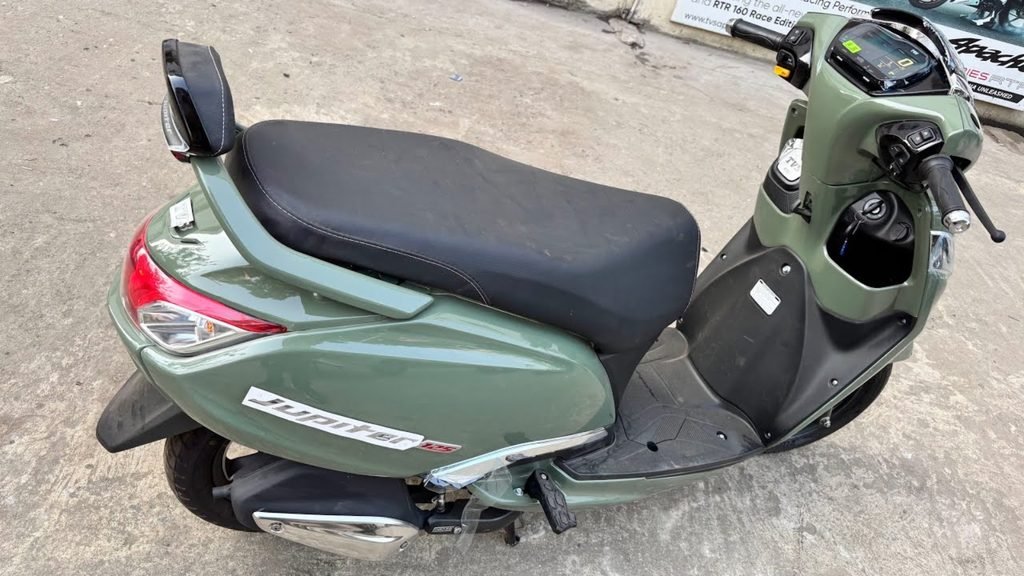
TVS counters with its fuel saving technology. The Jupiter 125 gets an idle stop start system and iGO Assist on higher variants. The latter provides an electric boost during initial acceleration.
Storage is another area where the Jupiter stands out. Its 33 litre under seat compartment is much larger than the Access’s 24.4-litre space. Suzuki makes up for it with two front storage pockets instead of one.
Overall, the Access puts more emphasis on safety and connected features while the Jupiter focuses more on practicality and convenience.
Suzuki Access 125 vs TVS Jupiter 125: Engine and Performance
| Specification | Suzuki Access 125 | TVS Jupiter 125 |
| Engine Type | 4-stroke, single-cylinder, SOHC | 4-stroke, single-cylinder, SOHC |
| Engine Cooling | Forced air-cooled | Forced air-cooled |
| Displacement | 124 cc | 124.8 cc |
| Fuel System | Electronic Fuel Injection | Electronic Fuel Injection |
| Max Power | 8.4 PS at 6,500 rpm | 8.15 PS at 6,500 rpm / 8.56 PS with iGO |
| Max Torque | 10.2 Nm at 5,000 rpm | 10.5 Nm at 4,500 rpm / 11.1 Nm with iGO |
| Transmission | CVT Automatic | CVT Automatic |
The two scooters are closely matched when it comes to their engines. Both use single cylinder petrol motors with CVT automatic transmissions.
The Access 125 makes slightly more power without any assistance system. The Jupiter produces a little more torque at lower engine speeds.
The Jupiter gets more of an advantage when the iGO Assist system is charged. The electric boost helps it pull away more quickly and makes short overtakes easier.
Verdict
Choosing between Suzuki Access 125 vs TVS Jupiter 125 comes down to what matters most to you.
The Suzuki Access 125 makes a stronger case if you prefer its neo retro styling and want a slightly lighter and more agile scooter. Its longer seat also works well for carrying a pillion. The availability of single channel ABS is another major advantage.
Also read: Tata Sierra EV Review
The TVS Jupiter 125 is the more practical choice. Its 33- itre under seat storage is a big plus for daily use. It also gets alloy wheels as standard and offers a pillion backrest on select variants. The longer standard warranty adds further value.
So, if style and braking safety are your priorities, the Access 125 is the better pick. If everyday practicality and storage matter more the Jupiter 125 makes a stronger case.